
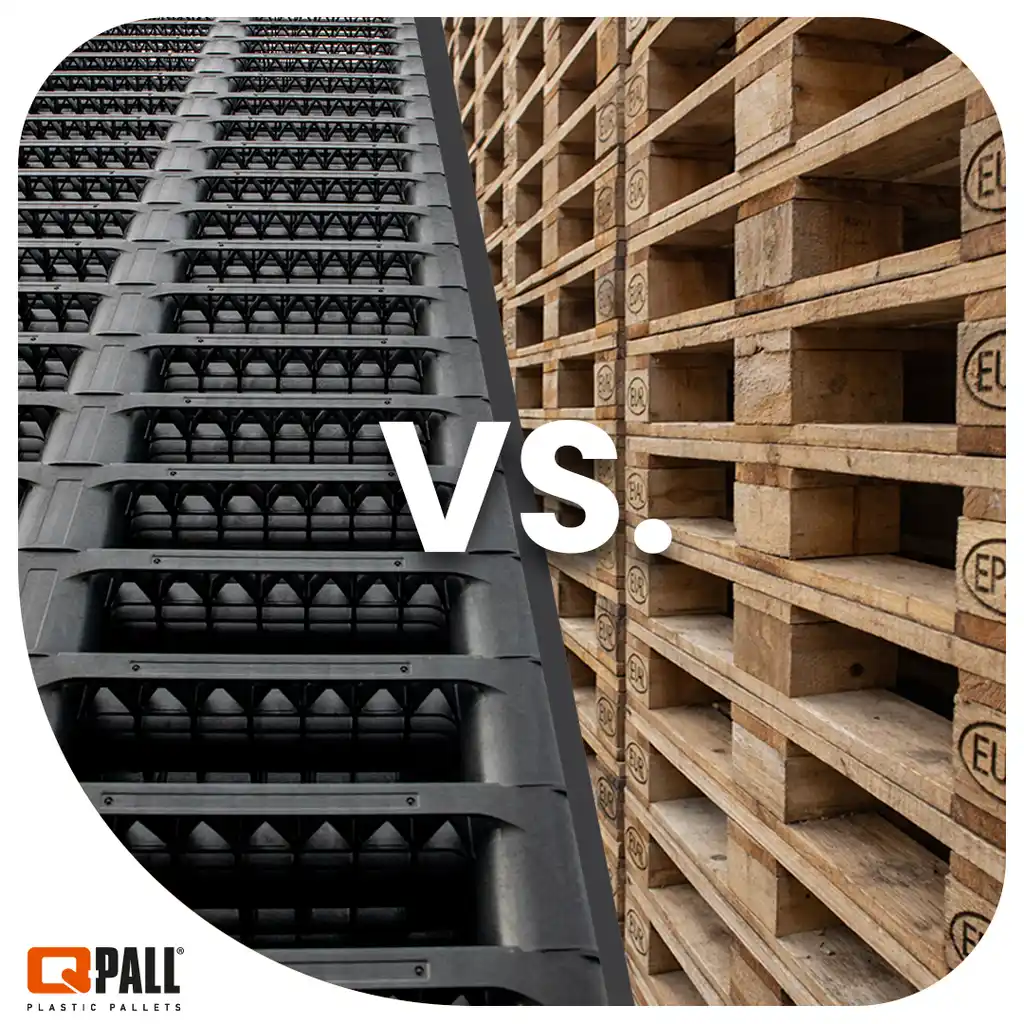
In most organizations, the pallet is the quietest link in the supply chain. No one sets a KPI for it. No one includes it in the annual report. It sits under the load, and that is that.
Until things go wrong.
A splinter in a hand or product. A wooden board just a little too narrow for the AGV sensor. A load that weighs 3 kilos heavier on the scale than on the packing slip. A mold spot on a pallet fresh from the outdoor warehouse. A customs agent asking for an ISPM-15 mark.
None of these incidents are separate from the pallet. All can be traced back to the properties of the material underneath.
Four essential elements that matter for your operational efficiency:
1. Non-porous
A pallet that does not absorb moisture also does not absorb mold, odor, or bacteria. For food processing, pharma, cold chains, and clean rooms, this is not an advantage — it is a strict prerequisite.
But it is also relevant outside those sectors. A dry matter shipment on a damp wooden pallet is a complaint in the making. A product on a pallet that has absorbed odor or residue equals a return.
What it delivers to the operation: less rejection, fewer returns, less discussion with the buyer about the state of the carrier.
2. No splinters
Splinters seem like a detail. Until someone tears a glove with one, damages a product, perforates packaging, or blocks a roller conveyor.
A pallet without splinters eliminates an entire category of minor incidents — the kind that never escalate, but continuously recur.
What it delivers to the operation: less product damage, less packaging damage, fewer safety reports, fewer interruptions on the shop floor.
3. The same weight, every time
Wooden pallets vary in weight. Per piece, per batch, per season. For those working with tare corrections — and that is everyone who invoices or transports by weight — this is a continuous source of inaccuracy.
A pallet with a constant weight allows your weighing system to do exactly what it needs to do. No retrospective calibration. No building in margins for uncertainty. No discrepancy between packing slip and weighbridge.
What it delivers to the operation: reliable tare, predictable freight costs, watertight administration.
4. The same dimensions, every time
Automation does not like variation. Palletizers, AGVs, conveyors, and stacking installations are adjusted to a specific footprint. A pallet that is 4 millimeters too wide, or missing an edge board, registers as a malfunction to a sensor.
A dimensionally stable pallet fits exactly the same mold every time. This is not a luxury — it is the basic requirement for an automated process that runs without manual intervention.
What it delivers to the operation: fewer line interruptions, higher throughput, lower maintenance costs on the automation system.
An additional compliance benefit
Besides what the pallet does within the process, there is an external condition where the material makes a difference.
ISPM-15. For export outside the EU, phytosanitary treatment and marking are mandatory for wooden packaging material. Plastic pallets are a preferred alternative as they fall outside this standard. No administration, no marking, no risk of rejection at the border.
Finally
A pallet might not be the most prominent item in your logistics chain. But it is an integral part of every transaction you make. Every pallet exchange, every weighing, every automated action.
The question is not which material is better. The question is what properties you need in your process — and what you gain if you no longer have to accept them as variable.
At Q-Pall, we manufacture pallets from 100% recycled plastic. Non-porous. No splinters. Constant in weight and dimensions. PPWR-supported. ISPM-15 free.