
What do the rules say about securing loads?
A load must be secured so that it does not fall off the vehicle or endanger its stability during an emergency stop, a swerve or on a poor road surface. The Dutch Regeling voertuigen, article 5.18.6 (Dutch vehicle regulations, in Dutch) sets minimum forces that the securing must be able to withstand.
| Direction | Minimum to withstand | For a loaded pallet of 800 kg |
|---|---|---|
| Forwards (direction of travel) | 0.8 x the weight of the load | force of 640 kg |
| Sideways | 0.5 x the weight (0.6 x if there is a risk of tipping) | force of 400 kg (480 kg) |
| Backwards | 0.5 x the weight of the load | force of 400 kg |
In addition, the load must be secured so that it cannot fall off due to upward forces from the vehicle. Anyone who transports goods or has them transported is responsible for a safely secured load. This is no formality: according to the European Commission, up to 25% of accidents involving trucks are linked to poorly secured cargo. That is why the Commission has also drawn up European guidelines on cargo securing.
How high can you load a pallet?
For general cargo, 220 cm for pallet plus load is often the limit. Carriers sometimes use other limits. With a plastic pallet 143 to 165 mm high, that leaves just over 2 metres for the load. The higher you stack, the sooner the load becomes unstable.
The load space also sets limits. A standard 13.6 metre trailer is 2.65 m high inside, a mega trailer 3 m. In storage, the height of the racking bay and the stability of the packaging determine how far you can go.
Practical rules of thumb for building the load:
- Heavy at the bottom. Put heavy boxes or products in the bottom layers.
- Nothing over the edge. Do not let the load overhang the edge of the pallet.
- Straight on top of each other. If you stack loaded pallets, place them exactly on top of each other, and only pallets of the same size and type.
Stacking loaded pallets on top of each other in storage? Then the bottom pallet carries the weight of all the pallets above it. Read how to calculate that in stacking plastic pallets.
How do you spread the weight on a pallet?
As evenly as possible over the whole deck, with the heaviest at the bottom. All load ratings of a pallet apply to an evenly distributed load. A point load, such as one heavy part on a small area, or a lopsided load reduces what the pallet can carry.
When moving the pallet, look at the dynamic load. Because of acceleration, braking and small shocks, it is lower than the static load. These are the values at Q-Pall, not counting display pallets:
| Load class | Static | Dynamic |
|---|---|---|
| Light | 2,500 kg | 1,000 kg |
| Medium | 5,000 to 7,500 kg | 1,250 to 1,500 kg |
| Heavy | 5,000 to 7,500 kg | 1,250 to 2,200 kg |
Read more about the three load values in the load capacity of plastic pallets. The forklift also plays a part: the centre distance between the forks is preferably about 60% of the width of the pallet. Other driving mistakes that damage load and pallet are listed in 9 common mistakes that damage plastic pallets.
Which pallet gives your load a stable base?
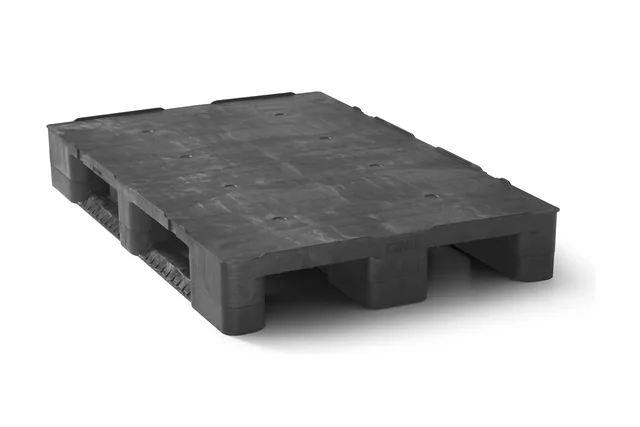
A pallet with runners is more stable than a pallet on feet, on the floor and on roller conveyors. A closed deck stops small packages sinking in or falling through. Also choose a load class whose dynamic load is well above the weight of your load.
- 3 runners: stable on the floor and on roller conveyors; in medium and heavy also suitable for racking.
- 5 or 6 runners: more support and a more even load distribution.
- 9 feet: light and often nestable, but less suitable for roller conveyors. You can click runners under many nestable pallets on site, without tools.
- Closed deck: flat and solid, handy for small boxes, trays and bags.
Film, straps or a pallet collar: which should you choose?
That depends on your load. Stretch film bundles boxes into one block, so they do not shift. Straps secure heavy or large items. Pallet collars keep small or loose goods together. Often a combination of a good pallet, a stable stack and one of these methods works best.
- Stretch film. The most common way to keep boxes in place. How many wraps you need depends on the load, the transport and the grip of the pallet deck.
- Straps. Suitable for heavy or large items. With straps over a lid, you secure the lid, collars and pallet together.
- Pallet collars and lids. A plastic pallet collar is 200 mm high. Stack several for more height and close it off with a lid. That way you transport loose or fragile goods in a closed, reusable box.
- A plastic pallet. Plastic pallets have no splinters or nails that damage the packaging, and they have constant dimensions. That makes the load unit predictable, also on roller conveyors.
When does an anti-slip pallet help?
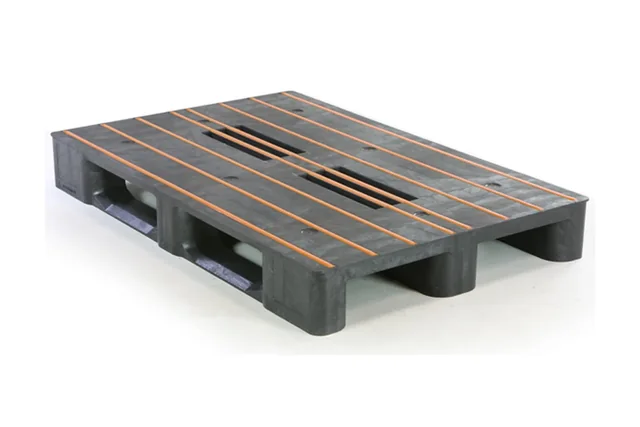
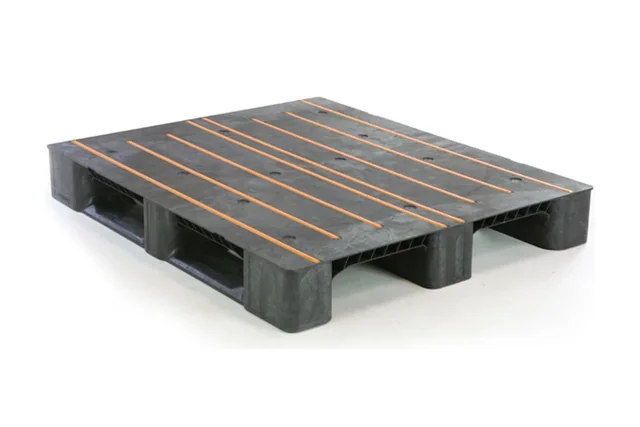
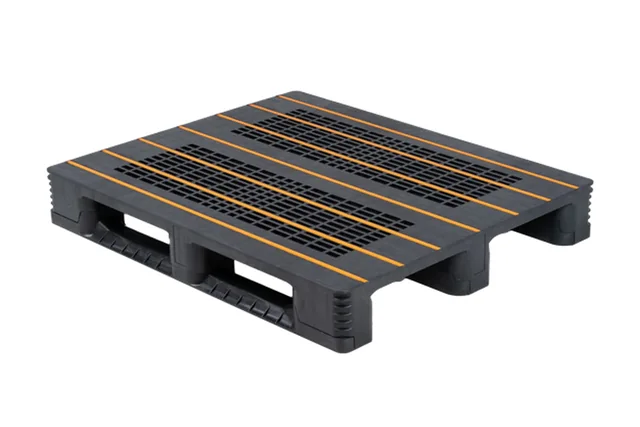
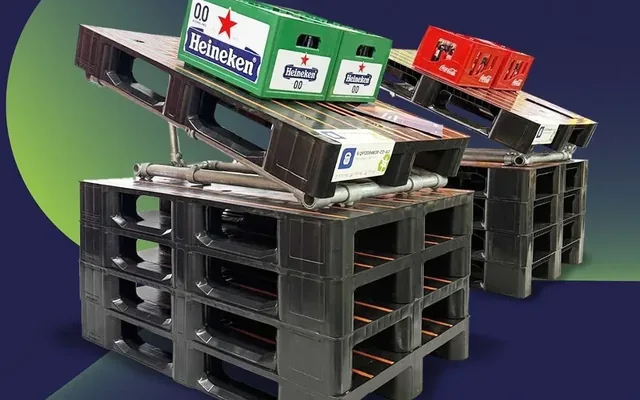
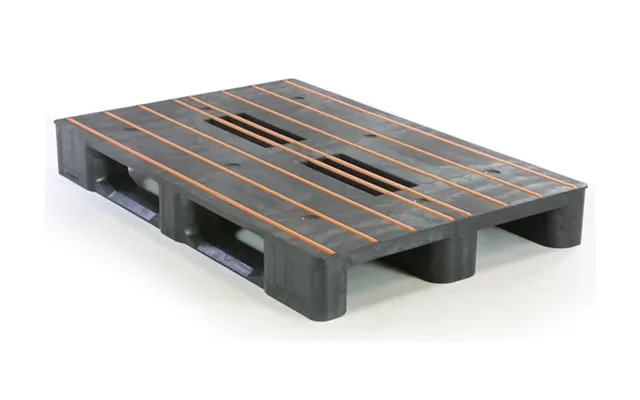
With smooth packaging, valuable or dangerous goods and fast processes with roller conveyors or AGVs. Strips of a rubber-like material (TPE) in the top deck give extra friction between pallet and load. Anti-slip is not a legal requirement, but it does help to keep your load safely in place.
Whether anti-slip is mandatory for you and when it makes sense is explained in detail in anti-slip pallets: are they mandatory? For your choice, these are the key points:
- Medium anti-slip pallets come in 1200 x 800 mm on 3 runners and in 1200 x 1000 mm on 3 or 5 runners, with a closed deck. They carry 6,000 kg static, 1,500 kg dynamic and 750 to 1,000 kg in racking. See anti-slip pallets.
- The Ultra pallet of 1200 x 1000 x 165 mm has anti-slip on the top and bottom. So the pallet itself is also less likely to slide on the forks or on a roller conveyor.
- Less film. Because the load stays on the deck better, you can often manage with fewer wraps. Film or straps cannot always be replaced by anti-slip: that depends on the load and the transport.
Anti-slip works particularly well with automation, where a shifted box can trigger a sensor. Read more in plastic pallets for automation.