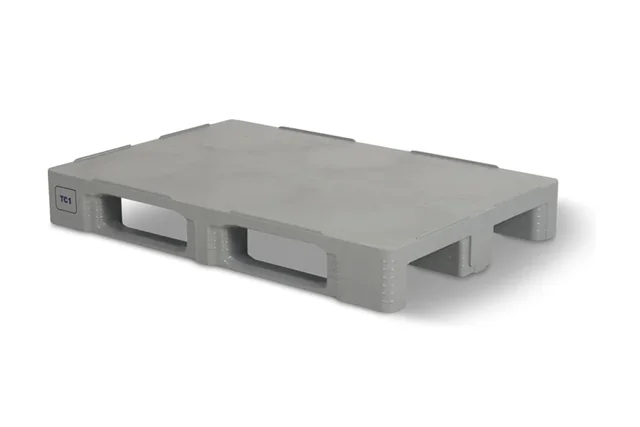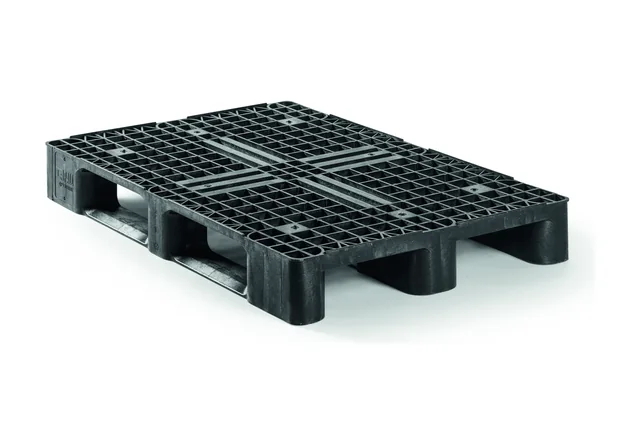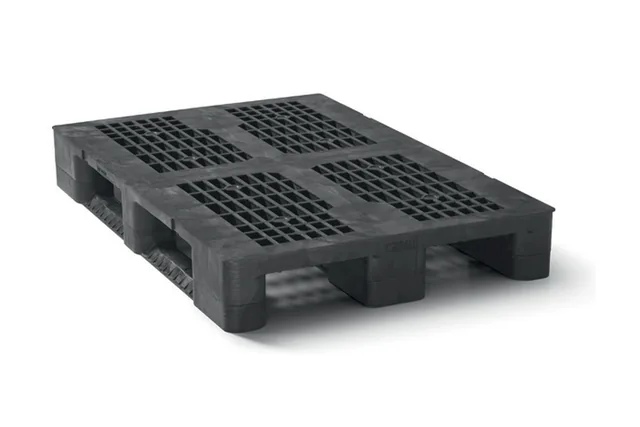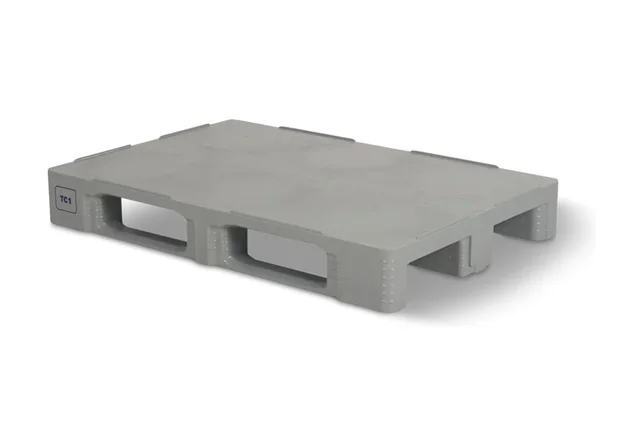

What are plastic pallets made of?
That varies per manufacturer and per type of pallet. We make our standard pallets from nearly 100% recycled plastic, a mix of HDPE and PP. Light pallets also contain LDPE. Only hygienic pallets, H1 pallets and cleanroom pallets are made of virgin plastic.
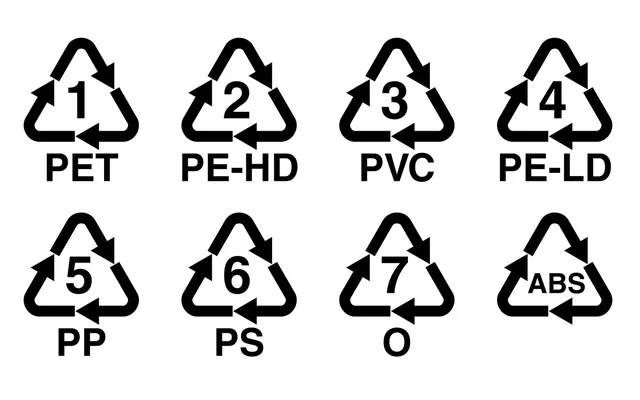
You can tell which plastic is used from the resin identification code (RIC code) in the small triangle. In Europe, these codes for packaging are laid down in Decision 97/129/EC.
| Plastic | Code | Characteristics | In Q-Pall pallets |
|---|---|---|---|
| HDPE (PE-HD) | 2 | Stiff and impact-resistant, density 0.94 to 0.97 g/cm³ | Light, medium and heavy, as a mix with PP |
| LDPE (PE-LD) | 4 | More flexible than HDPE, mainly used for film and bags | Light pallets, alongside HDPE and PP |
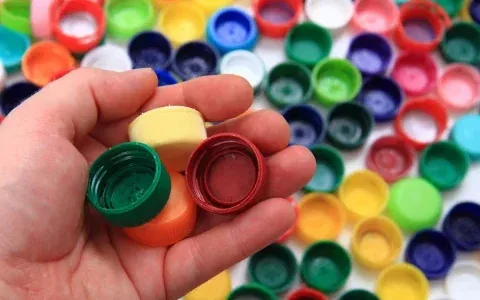
| PP | 5 | Polyolefin, related to HDPE, used for crates, caps and buckets | Light, medium and heavy, as a mix with HDPE |
| Other (O) | 7 | Catch-all category for other plastics and combinations | Not in our standard pallets |
Read more about the codes in resin identification codes.
What is the difference between HDPE and PP?
HDPE is high-density polyethylene, PP is polypropylene. Both are polyolefins: related plastics that behave in a similar way in recycling and are often processed together. That is why they can be used as a mix in a pallet. The load ratings of every Q-Pall model apply to that mix.
HDPE is a thermoplastic. It softens when heated and hardens when cooled, and that can happen again and again. That makes it easy to recycle. In addition:
- Strong and impact-resistant, even at freezing temperatures.
- Light. Its density is lower than that of water, so HDPE floats. In recycling, that helps to separate it from heavier plastics such as PET and PVC.
- Does not absorb moisture, so no mould or rot.
- Resistant to many acids, alkalis and solvents.
- No plasticisers needed. HDPE contains no phthalates or BPA.
Read more about this material in recycled PE-HD 2: what is it exactly?
What is the difference between recycled and virgin plastic?
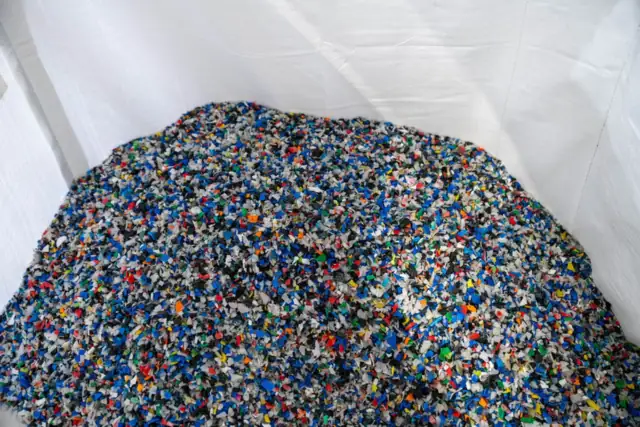
Virgin plastic is new plastic, made directly from raw material. Recycled plastic comes from waste streams and has been used before. It behaves differently from virgin plastic and changes slightly with every recycling cycle. That is why producers carefully match the recyclate to the application.
| Characteristic | Recycled plastic | Virgin plastic |
|---|---|---|
| Origin | Waste streams such as crates, caps and packaging | New raw material |
| Q-Pall pallets | All standard pallets: light, medium and heavy | Hygienic pallets, H1 pallets and cleanroom pallets |
| Direct contact with food | Not intended | Yes, intended for it |
| Example load | Heavy up to 7,500 kg static and 1,375 kg racking | Hygienic up to 7,500 kg static and 2,000 kg racking |
| Purchase price | Lower | Higher |
| End of life | Fully recyclable | Fully recyclable |
In 2025, Q-Pall processed 34,500 tonnes of recycled plastic, about 1,475 full trucks. Working with recyclate takes a lot of know-how. The material is checked for particle size and composition, among other things; if it contains too much film or other dirt, it is not used. We have been building up that know-how since 2005.
Is a pallet made of recycled plastic just as strong?
Yes, provided the design and the material are well matched. Every model has fixed values for static, dynamic and racking load. Our heavy pallets made of recycled HDPE and PP carry up to 7,500 kg static and up to 1,375 kg in racking. That does not come at the expense of service life.
So when choosing, do not look at the material alone, but at the load ratings of the model and how you use the pallet. Read how those values work in the load capacity of plastic pallets.
When should you choose virgin plastic?
Choose virgin plastic when food comes into direct contact with the pallet. Recycled plastic may only come into contact with food if it comes from an authorised recycling process. This has not yet been established for recycled HDPE from municipal collection. That is why our hygienic, H1 and cleanroom pallets are made of virgin plastic.
The European rules for materials that come into contact with food are set out in Regulation (EC) No 1935/2004 and, for plastics, in Regulation (EU) No 10/2011. See the overview of EU legislation on food contact materials. Regulation (EU) 2022/1616 applies to recycled plastic. According to the European Commission, there are currently two suitable recycling technologies: mechanical recycling of PET and recycling from a closed, controlled chain. See the explanation of plastic recycling for food contact.
In short:
- Food directly on the pallet: a hygienic pallet made of virgin plastic.
- Cleanrooms and pharma: a cleanroom pallet made of virgin plastic.
- Packaged products, storage, distribution, export and chemicals: a pallet made of recycled plastic.
Read more about the rules and the choice per situation in hygienic pallets and HACCP.
What should you look for when buying?
Ask about the composition. A good supplier will tell you which plastics the pallet is made of and what happens to it at the end of its life. With code 7, you often do not know what is in it, and such plastics are often difficult to recycle.
- Composition. Pallets from one material family, such as HDPE and PP, are easier to recycle than combinations.
- Documentation. Under the European packaging regulation PPWR, you can ask the manufacturer for a declaration of conformity. From 2030, packaging must be recyclable to at least grade C (70%).
- Take-back. Ask whether the supplier takes pallets back. Q-Pall grinds discarded pallets into raw material for new pallets.
Read how long a pallet lasts and what happens next in service life and recycling of plastic pallets. You can find more about our approach on the sustainability page.