
What is the difference between nestable and stackable?
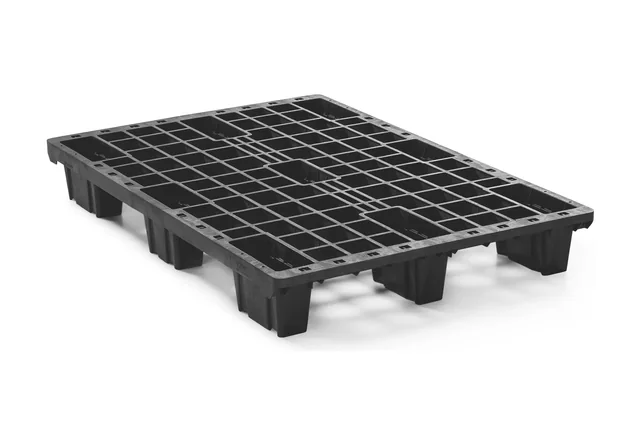
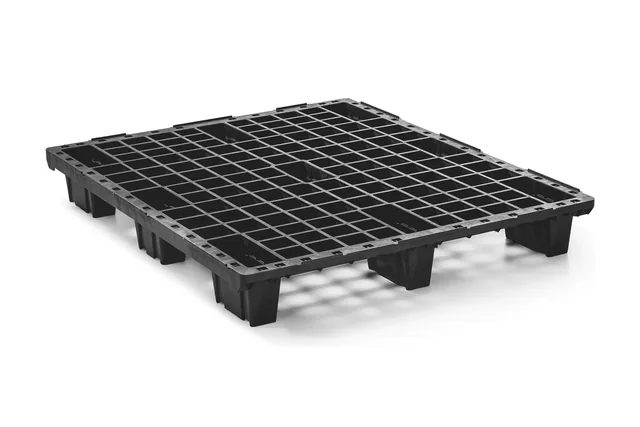
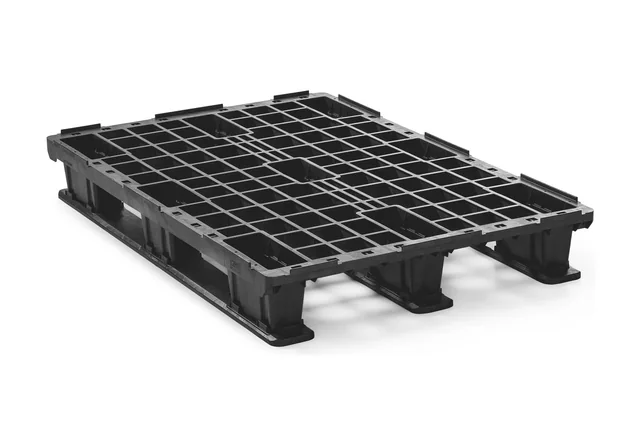
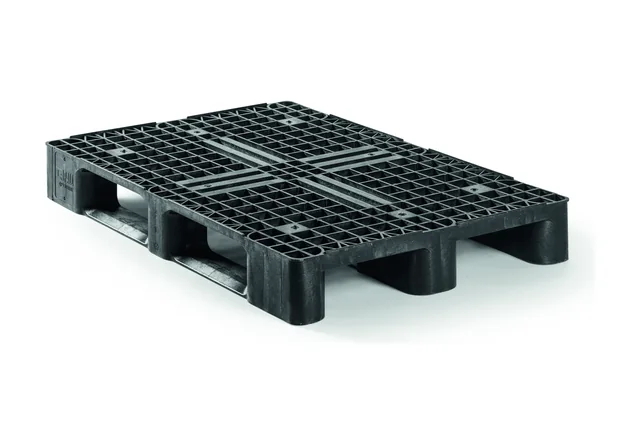
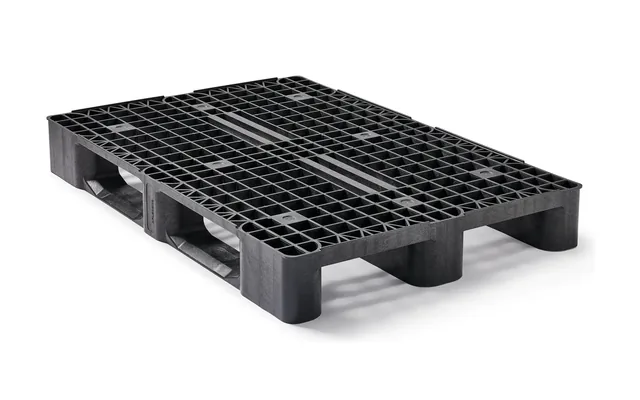
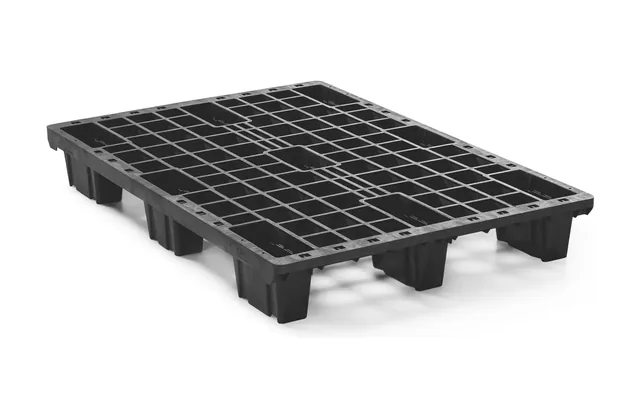
A nestable pallet has hollow, tapered feet. When empty, you slide it into the pallet below, like plastic cups. A stackable pallet has runners and you place it on top of the previous one when empty. When loaded, you can put both types on top of each other, within the static load of the bottom pallet.
So the word "stackable" says something about how empty pallets sit on top of each other. With a stackable pallet, every pallet in the stack counts for its full height. With a nestable pallet, each next pallet sticks out only a few centimetres above the previous one.
At Q-Pall, the nestable pallets are mainly light pallets on 9 feet, in 1200 x 800, 1200 x 1000, 1100 x 1100, 1140 x 1140, 1200 x 1200 and 760 x 1140 mm. There are also nestable display pallets of 600 x 400 and 600 x 800 mm. The light pallets with 3 runners are nestable too: these are pallets with click-on runners, which are delivered loose alongside the nested pallets. Medium and heavy pallets have fixed runners (3, 5 or 6) and are stacked.
How much space does a nestable pallet save?
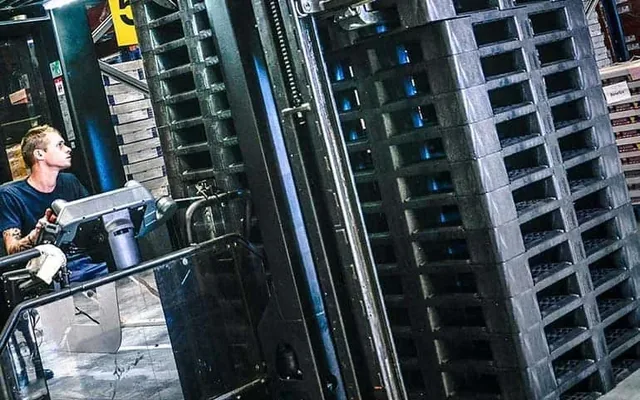
A stack of 45 nestable Euro pallets is 2.36 metres high. A stack of about the same height holds 17 medium or 15 heavy Euro pallets with runners. Each extra nestable pallet adds only about 5 cm. So you carry almost three times as many empty pallets per truck.
For comparison: a wooden EPAL Euro pallet is 144 mm high and does not nest. A stack of 2.36 metres holds sixteen of them.
This is how the three versions of the plastic Euro pallet (1200 x 800 mm) compare:
| Light, 9 feet (nestable) | Medium, 3 runners | Heavy, 3 runners | |
|---|---|---|---|
| Pallets per stack | 45 | 17 | 15 |
| Stack height | 2.36 m | 2.47 m | 2.39 m |
| Per 13.6 m trailer | 1,485 | 561 | 495 |
| Per mega trailer | 1,815 | 627 | 594 |
| Per 40 ft high cube container | 1,081 | 391 | 345 |
| Weight per pallet | 5.1 to 5.4 kg | 11.4 to 12 kg | 16.9 kg |
| Static load | 2,500 kg | 5,000 kg | 7,500 kg |
| Dynamic load | 1,000 kg | 1,250 to 1,500 kg | 1,750 kg |
| Racking load | Not for racking | 450 to 500 kg | 1,000 kg |
The numbers per truck and container come from the load calculator. You can find more sizes in the guide how many pallets fit in a truck or container?
How much can a nestable pallet carry?
The nestable light pallets on 9 feet carry 2,500 kg static and 1,000 kg dynamic. That is enough for most transport and export loads. They have no racking load rating: they are made for transport and floor storage, not for pallet racking without decking.
Pallets with runners carry more and are also available for racking. Medium pallets carry 5,000 to 7,500 kg static, heavy pallets up to 7,500 kg static and up to 2,200 kg dynamic. In racking, the pallet rests only on two beams and the middle is unsupported. That calls for sturdy runners. Read about the difference between static, dynamic and racking load in the load capacity of pallets.
The nestable display pallets carry less: the medium display pallet of 600 x 400 mm 500 kg static and the heavy display pallet of 600 x 800 mm 1,000 kg static.
When should you choose a nestable pallet?
Choose a nestable pallet if the pallet does not come back, or comes back empty, and space or weight matters. Typical situations are one-off shipments, export, seasonal peaks and return flows of empty pallets. You store them compactly, carry many more per trip and they are easy to handle.
- Export. Plastic pallets do not fall under ISPM 15, the standard for wood packaging material. So you do not need to have anything treated or stamped.
- Return of empty pallets. Almost three times as many pallets per trip means fewer trips.
- Storing a stock of empty pallets. A stack takes up a fraction of the space.
- Air freight and manual handling. A nestable Euro pallet weighs just over 5 kg.
Note: a nestable pallet stands on feet. On a roller conveyor and in a stack of loaded pallets, it is less stable than a pallet with runners. Want both? Then read on about the click-on runners below.
When should you choose a pallet with runners?
Choose a pallet with runners if the pallet comes back often, goes into racking or runs over roller conveyors. Runners spread the load over the floor and the beams and give a stable base. Medium and heavy pallets with runners are made for internal transport, distribution, pools and racking storage.
- Pallet racking. Place the pallet with the runners at right angles to the beams.
- Roller conveyors and automation. Continuous runners run better than separate feet.
- Block stacking. Loaded pallets with runners are more stable in a stack than pallets on feet.
- Intensive use. A heavier pallet lasts many trips.
Read more about the construction of the deck and base in how a pallet is built.
Can you combine nesting and runners?
Yes. You can click 3 runners under many nestable pallets with 9 feet, without tools. That is also how Q-Pall supplies the light pallets with 3 runners: nested, with the click-on runners loose. You transport and store the pallets nested and only make them more stable at their destination. That way you keep the space advantage of nesting and still get a pallet that runs better on roller conveyors.
The click-on runners are 1170 mm long and 100 mm wide, in a low version of 15 mm and a high version of 30 mm. They fit under the nestable pallets of 1200 x 800 and 1200 x 1000 mm; the low version also fits under 760 x 1140 mm. For the square nestable pallets, there are standard runners in the length of the pallet. You use 3 runners per pallet.
The load calculator can include the loose runners. They are loaded separately on pallets, next to the stacks of nested pallets.
Not sure which version suits your process? Read the guide choosing the right plastic pallet.