
Is a hygienic pallet mandatory under HACCP?
No, HACCP does not name a type of pallet. However, Regulation (EC) No 852/2004 does require food businesses to put in place and maintain a permanent procedure based on the HACCP principles. You map the risks in your own process, including storage and transport, and choose a pallet that fits.
The obligation applies to businesses that handle food after primary production: from processing and packaging to transport, storage and sale. The HACCP principles come down to seven steps:
- Identify the hazards that you must prevent, eliminate or reduce.
- Determine the critical control points.
- Set a critical limit for each control point.
- Monitor the control points.
- Set corrective actions for when things go wrong.
- Regularly verify that the measures work.
- Record everything in documents and records.
In the Netherlands, you draw up a food safety plan based on HACCP or work with an approved hygiene code for your sector (Dutch government source, in Dutch). The NVWA supervises this there. Read how HACCP affects storage and transport in pallets and HACCP.
What does Regulation 852/2004 require of equipment and transport?
Under Annex II of the regulation, articles and equipment that come into contact with food must be effectively cleaned and, where necessary, disinfected. They must also be constructed, be made of such materials and be kept in such good condition that the risk of contamination is kept to a minimum.
Something similar applies to transport: conveyances and containers for food must be clean and in good condition, and where necessary easy to clean and disinfect. If food lies directly on the pallet, the pallet falls under these requirements. With packaged products, the pallet is part of your storage and transport and belongs in your risk analysis.
A pallet that does not absorb moisture, does not go mouldy, does not shed splinters and is easy to clean makes it easier to meet these requirements. Wood is porous and can harbour pests; plastic cannot. The European Commission gives an overview of the food hygiene legislation.
What does Regulation 1935/2004 cover for food contact?
Regulation (EC) No 1935/2004 applies to materials and articles that are intended to come into contact with food, or can reasonably be expected to do so. They must not transfer their constituents to food in quantities that could endanger human health, bring about an unacceptable change in its composition or affect its smell and taste.
The regulation also requires traceability at all stages, so that the origin and customers of materials are known. For plastics, Regulation (EU) No 10/2011 also applies. It contains a list of authorised substances, an overall migration limit of 10 mg per dm² and the obligation to pass on a declaration of compliance along the chain. See the overview of the EU rules for food contact materials.
Why virgin plastic for direct food contact?
Recycled plastic may only come into contact with food if it comes from an authorised recycling process, under Regulation (EU) 2022/1616. According to the European Commission, there are currently two suitable technologies: mechanical recycling of PET and recycling from a closed, controlled chain. This has not yet been established for recycled HDPE from municipal collection.
We make our standard pallets from nearly 100% recycled plastic from mixed waste streams, such as crates, caps and packaging. They are a good choice for packaged products, but not intended for direct contact with food. For that, we make hygienic pallets from virgin (new) plastic, in a colour of their own. Read more about the difference in recycled or virgin plastic. The Commission describes the current state of play on recycled plastic for food contact on its page about plastic recycling.
Which pallet suits which situation?
Look at whether the product is packaged, how wet the environment is and how often you clean. The more direct the contact with food and the wetter the area, the more a smooth, closed deck made of virgin plastic pays off. For packaged products in dry storage and distribution, a standard pallet is enough.
| Situation | Pallet | Deck | Why |
|---|---|---|---|
| Packaged food in boxes, crates or film | Standard pallet made of recycled plastic | Open or closed | No direct contact with the food |
| Unpackaged food directly on the pallet | Hygienic pallet made of virgin plastic | Closed | Direct food contact, quick to clean |
| Meat, fish and wet areas | Hygienic pallet or H1 pallet | Preferably closed | Moisture must not drip onto the load below |
| Pharma and cleanrooms | Cleanroom pallet or hygienic pallet | Closed | Smooth, no fibres or splinters |
Read more per sector in the food industry and the pharmaceutical industry.
What makes a pallet hygienic?
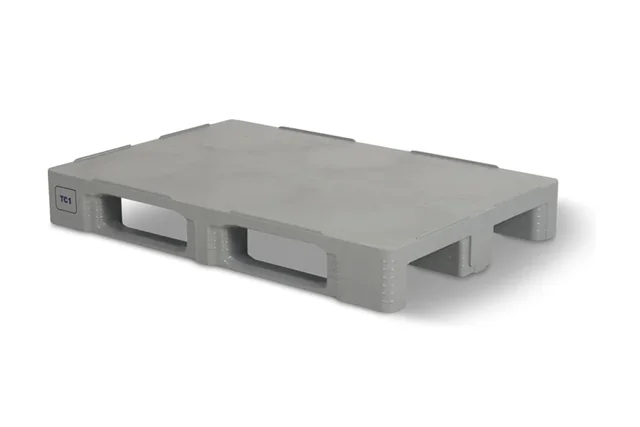
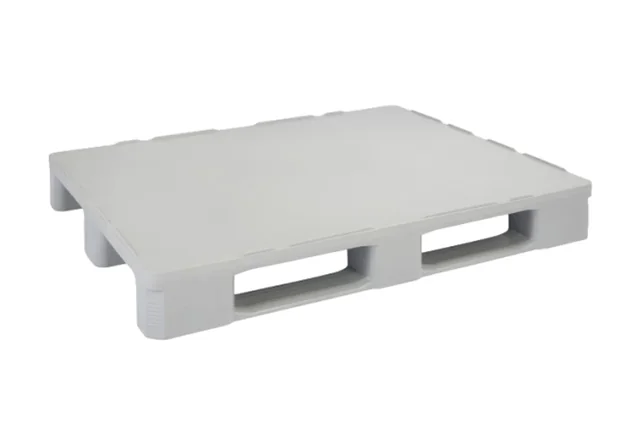
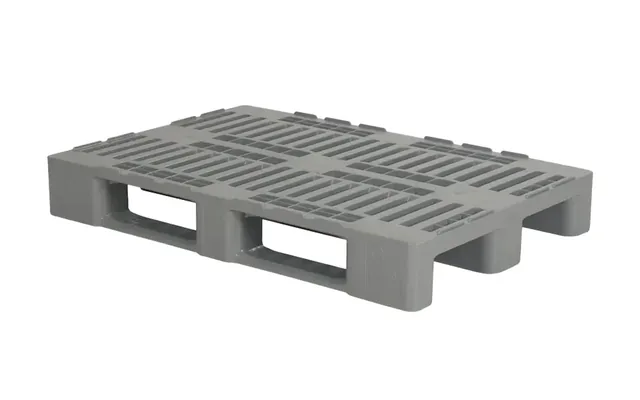
A hygienic pallet has a smooth design that is as closed as possible, with as few seams and corners as possible where dirt can build up. It does not absorb moisture, can withstand intensive cleaning and has no splinters or nails. A closed deck is the quickest to clean; with an open deck, moisture drains away.
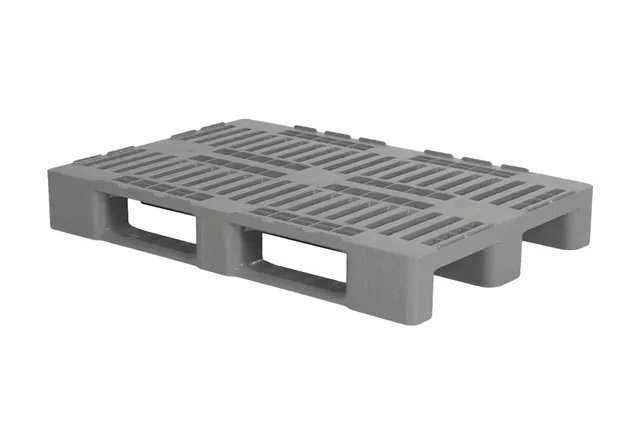
The best-known hygienic pallet is the H1 pallet, a plastic Euro pallet developed as a pool pallet for the meat industry. The Q-Pall range at a glance:
| Version | Dimensions (mm) | Deck and base | Weight | Static | Dynamic | Racking |
|---|---|---|---|---|---|---|
| Hygienic pallet | 1200 x 800 x 160 | Closed, 3 runners | 18 kg | 7,500 kg | 1,500 kg | 1,000 to 1,750 kg |
| Hygienic pallet | 1200 x 800 x 160 | Open, 3 runners | 19 kg | 7,500 kg | 1,750 kg | 1,750 kg |
| H1 Euro pallet | 1200 x 800 x 160 | Open, 3 runners | 18 kg | 5,000 kg | 1,250 kg | 1,000 kg |
| Hygienic pallet | 1200 x 1000 x 160 | Closed, 3 runners | 21.5 kg | 7,500 kg | 1,500 kg | 1,250 to 2,000 kg |
| Cleanroom pallet | 1200 x 800 x 160 | Closed, 3 runners | 18 kg | 5,000 kg | 1,250 kg | 1,000 kg |
| Cleanroom pallet | 1200 x 1000 x 160 | Closed, 3 or 5 runners | 21 to 26 kg | 7,500 kg | 1,500 to 2,000 kg | 1,250 kg |
The load ratings apply to an evenly distributed load. Where a range is given, the value differs per version.
How do you keep hygienic pallets clean?
Record in your hygiene plan how often you clean the pallets, with which agents, whether you disinfect afterwards and who checks this. Clean first, rinse, and only then disinfect, if your plan requires it. Take a pallet with cracks or breaks out of circulation.
A complete method, from pre-rinsing to drying and choosing an approved disinfectant, is set out in cleaning and disinfecting plastic pallets.
This guide is a summary, not legal advice. Not sure which pallet suits your HACCP plan? Contact us.