
How does the EPAL exchange system work?
In the open exchange system, almost every recipient in Europe has an empty Euro pallet ready to swap for the loaded pallet that comes in. That way, nobody has to collect empty pallets separately. The system revolves around wooden EPAL Euro pallets of 1200 x 800 x 144 mm, with a fixed mark.
The EPAL Euro pallet weighs about 25 kg and has a safe working load of 1,500 kg. To remain exchangeable, a pallet must meet clear requirements. It can no longer be exchanged if, for example, a board or block is missing, a board is broken, or the wood is rotten or heavily soiled. Only a licensed repair company may repair it. EPAL explains how the exchange system works in broad terms on its page about the exchange system.
Can plastic pallets be part of pallet exchange?
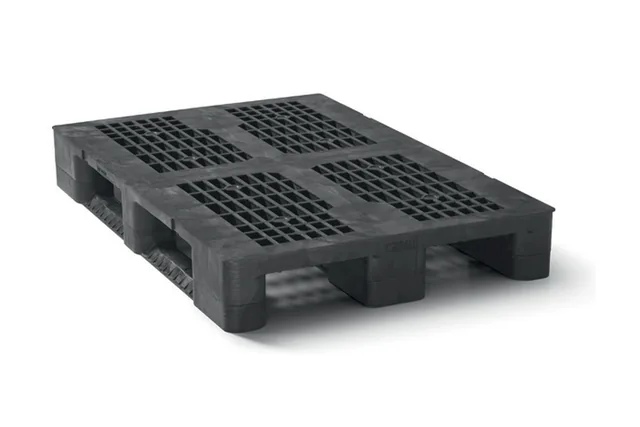
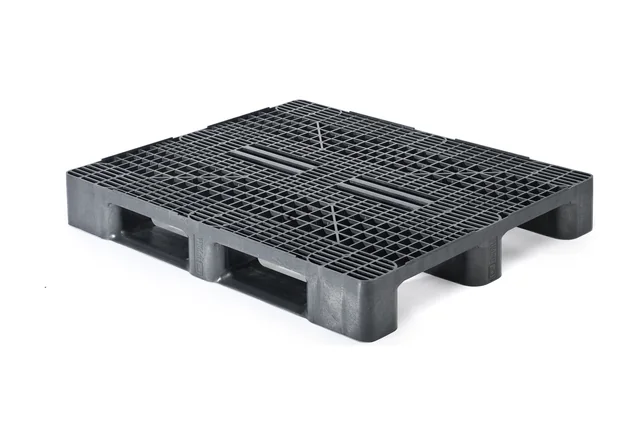
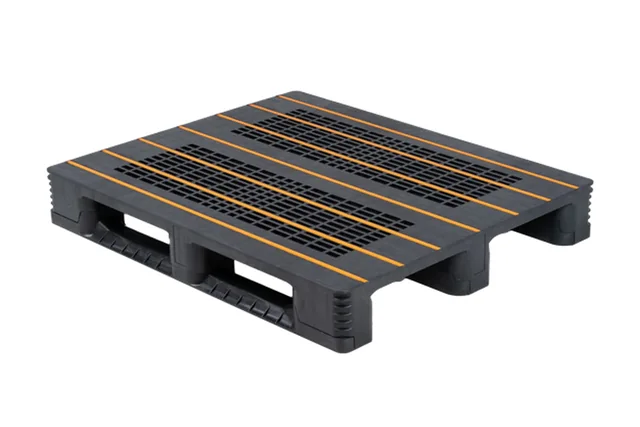
No. Q-Pall plastic pallets have the same dimensions as the Euro pallet, but are not part of the EPAL or Europool exchange system. So you cannot swap them at the recipient for a stamped wooden pallet. That is why plastic Euro pallets are mainly used in closed loops, in pools, for internal transport and for export.
They do fit in the same racking, trucks and roller conveyors as the wooden Euro pallet. The differences at a glance:
| Wooden EPAL Euro pallet | Plastic Euro pallet (Q-Pall) | |
|---|---|---|
| Dimensions | 1200 x 800 x 144 mm | 1200 x 800 mm, 145 to 160 mm high |
| Weight | about 25 kg | 5.1 kg (nestable) to 23 kg (heavy) |
| Exchangeable in the open exchange system | Yes, if in exchangeable condition | No |
| Maintenance | Repair by a licensed company | No loose boards or nails; a damaged pallet is taken out of use and goes back for recycling |
| Use | Open exchange between many parties | Own closed loop, pool, internal transport, export |
When should you choose your own closed loop or pool?
When your pallets keep circulating between the same sites, customers or suppliers. You then manage the pallets yourself, or a pool operator handles issue, return, inspection and repair. Because a plastic pallet lasts for many years, the cost per trip in such a loop counts for more than the purchase price.
A pool works well if a few conditions are met:
- The right pallet. A pool pallet is not a separate type: any light, medium or heavy pallet can go into a pool, as long as it suits the load, the processes and the required service life. If the pallet goes into racking, choose medium or heavy.
- Fixed size and weight. All participants count on the same dimensions, the same weight and the same load capacity. Pools mainly use 1200 x 800, 1200 x 1000 and 600 x 400 mm.
- Recognisability. A logo, your own colour or a marking makes your pallets recognisable in the chain. See custom solutions. Pallets can also be fitted with an RFID tag, so you can track them better.
- Good management. The success of a pool depends at least as much on its management as on the pallet itself: less loss and damage, faster circulation and lower costs.
One example is Drankenpallet Beheer Nederland, the pool of the Dutch beverage industry. For this pool, Q-Pall is producing at least one million pallets up to 2034. Read more about pools in plastic pallets for pooling.
Legislation is also pushing towards reuse. Under the PPWR, from 1 January 2030 at least 40% of the transport packaging you use within the EU must be reusable and part of a reuse system. For transport between your own sites or within one member state, 100% applies in principle, with some exemptions. See PPWR and plastic pallets.
How do you organise the return flow of empty pallets?
By taking back as many empty pallets as possible per trip. You stack empty plastic pallets on top of each other and slide nestable pallets into each other. That way a 13.6 metre trailer takes 495 to 598 empty Euro pallets with fixed runners, or 1,485 nestable ones, against 33 loaded pallets on the outbound trip.
According to the load calculator, this is how many empty pallets fit in one load:
| Pallet | Trailer 13.6 m | Mega trailer | 40 ft high cube |
|---|---|---|---|
| Euro pallet heavy, 3 runners | 495 | 594 | 345 |
| Euro pallet medium, 3 runners | 561 | 627 | 391 |
| Euro pallet light, 3 click-on runners (nested, runners loose) | 1,170 | 1,430 | 846 |
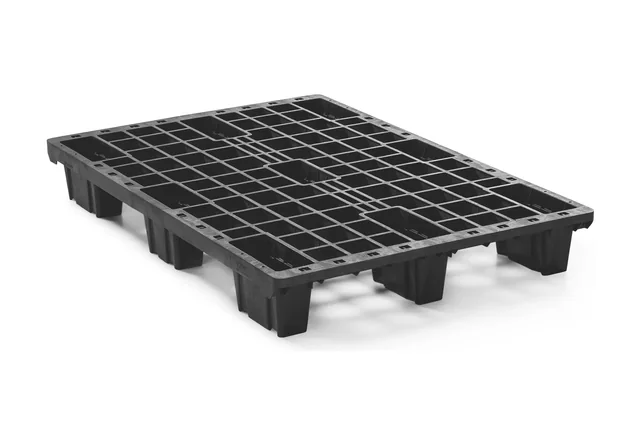
| Euro pallet nestable, 9 feet | 1,485 | 1,815 | 1,081 |
| 1200 x 1000 mm heavy, 3 runners | 390 | 468 | 300 |
| 1200 x 1000 mm nestable, 9 feet | 1,170 | 1,430 | 940 |
So one return trip with 495 empty heavy Euro pallets brings back the pallets from 15 full trailers of 33 pallets. A mega trailer is as long as a standard trailer, but 3 m high inside instead of 2.65 m: with stacked empty pallets, up to just over 20% more fit. Nestable pallets bring back almost three times as many as pallets with runners. Agree with your customers who collects the empty pallets, how they are stacked and when they are picked up. With nestable pallets and loose runners, you can fit the runners on site, so you keep transporting the pallets nested.
When is an export pallet smarter than a return trip?
When the pallet does not come back or a return flow does not pay off, for example when exporting outside the EU. You then choose a light export pallet that stays with the recipient. Q-Pall plastic export pallets are always light, often nestable and need no ISPM 15 treatment for export outside the EU.
Light export pallets carry up to 2,500 kg static and 1,000 kg dynamic and are intended for transport and floor storage, not for racking. They weigh from 2.7 kg, which saves on freight costs, and when empty you slide the nestable models into each other. Wooden pallets usually have to be treated and stamped for export outside the EU; plastic falls outside ISPM 15.
Are pallets leaving your loop after a number of years? They do not have to be thrown away. With Q-Used, we buy used pallets, inspect them and sell them again. We take back pallets that can no longer be used and grind them into raw material for new pallets. Want to calculate your return flow? Then use the load calculator.