
Which load counts in pallet racking?
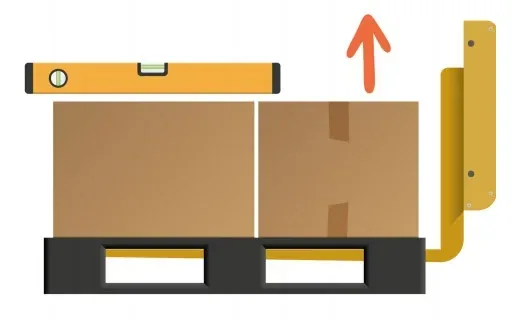
In pallet racking without decking, the racking load is what counts. The pallet then rests only on two beams and the middle is unsupported. That is why this is almost always the lowest of the three load values. For Q-Pall pallets, the racking load is between about 3% and 28% of the static load.
You can read exactly what static, dynamic and racking load mean and how we test in the load capacity of plastic pallets. This guide is about practice: which pallet to choose, how to place it in the racking and what to watch out for.
Internationally, ISO 8611-1 (linked here via NEN, the Dutch standards body) describes the test methods for flat pallets, including tests for the maximum working load. For the pallet in your racking, what ultimately counts is the value the manufacturer gives for each model.
How much does a plastic pallet carry in racking?
That depends on the size and the load class. Q-Pall medium pallets carry 200 to 1,375 kg in racking, heavy pallets 800 to 2,000 kg. Light pallets and display pallets have no racking load rating. The table shows the range per size across all versions with runners.
| Size | Medium | Heavy |
|---|---|---|
| 1200 x 800 mm | 450 to 750 kg | 800 to 1,750 kg |
| 1200 x 1000 mm | 750 to 1,375 kg | 850 to 2,000 kg |
| 1100 x 1100 mm | 250 kg | 1,000 to 1,250 kg |
| 1140 x 1140 mm | 200 to 300 kg | 1,250 to 1,375 kg |
| 1200 x 1200 mm | 250 kg | 1,375 kg |
| 1300 x 1100 mm | not available | 1,375 kg |
Within one size, the difference can be large. So for a specific load, always look at the value of the model itself, not at the average for the size.
What determines the racking load of a pallet?
Mainly the load class, the size, the top deck and the number of runners. A heavier construction carries more. With the same base, a closed deck or extra runners sometimes give a higher value. How the pallet lies on the beams then determines whether you actually achieve that value in practice.
A few examples from our range:
- Load class. A medium pallet of 1100 x 1100 mm carries 250 kg in racking, a heavy pallet in the same size 1,000 to 1,250 kg.
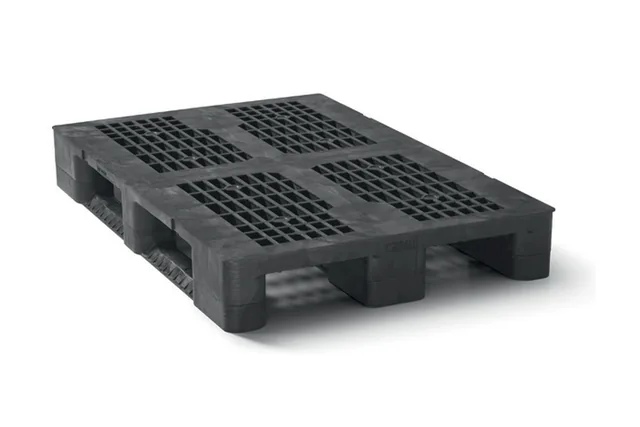
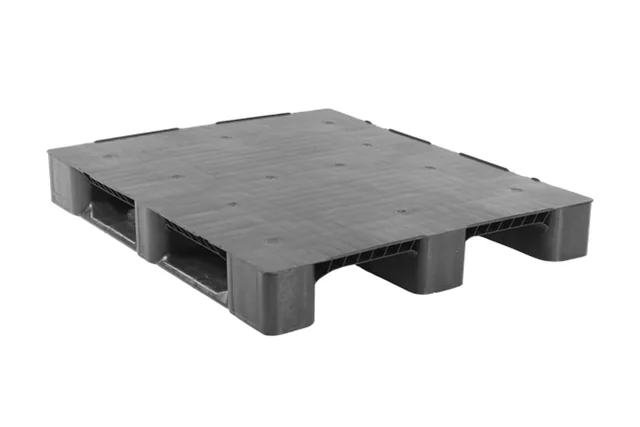
- Top deck. The medium Euro pallet carries 450 to 500 kg with an open deck and 650 to 750 kg with a closed deck. For a medium pallet of 1200 x 1000 mm, the value goes from 750 to 1,375 kg with a closed deck.
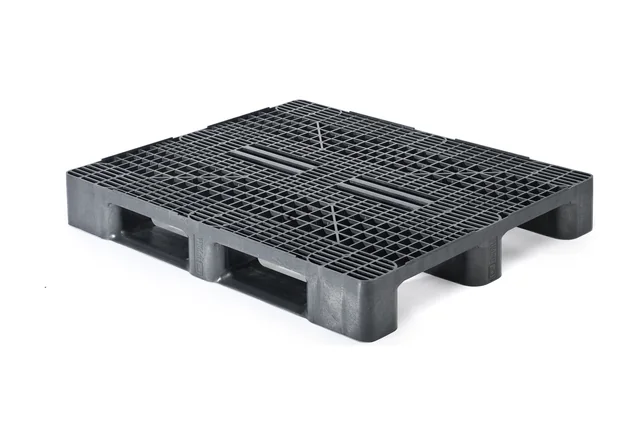
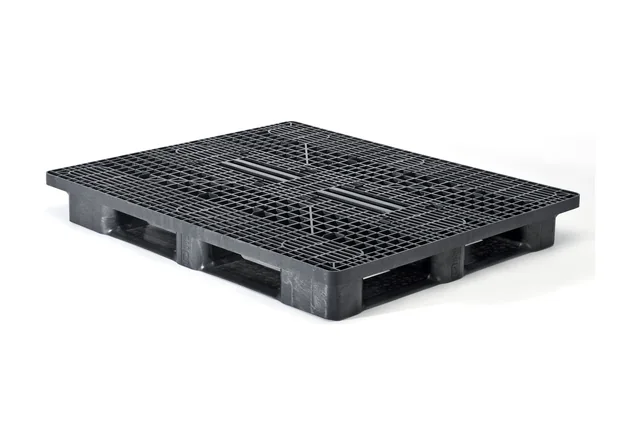
- Runners. The heavy pallet of 1100 x 1100 mm carries 1,000 kg on 3 runners and 1,250 kg on 6 runners. For the Ultra pallet of 1200 x 1000 mm, that is 1,250 and 1,375 kg.
- Size. The square medium pallets carry 200 to 300 kg in racking. The medium block pallets of 1200 x 1000 mm carry up to 1,375 kg.
So a closed deck or more runners is no guarantee of a higher racking load. For many heavy pallets, the value is the same with an open and a closed deck.
How do you place a plastic pallet on the beams?
With the runners at right angles to the beams, so that the pallet is supported by its runners on both beams. That is also how the racking load is determined: in conventional pallet racking, with the runners on two beams and no shelf underneath. If the pallet lies differently, the stated value does not automatically apply.
In practice, pay attention to the following:
- Straight and centred in the bay. Put the pallet down straight, with both sides properly on the beams.
- Horizontal forks. Drive in and out with horizontal forks and only turn away when the forks are completely out of the pallet. Read about more driving mistakes in 9 common mistakes that damage plastic pallets.
- A different racking system. In drive-in racking, flow racking or shuttle systems, the pallet is supported differently than in conventional racking. In that case, discuss with us which value applies. See also plastic pallets for automation.
- Shelf or mesh deck. If the pallet lies on a shelf or mesh decking, it is supported over a wider area. Which value then applies depends on that support.
- The racking itself. Beams and uprights also have a maximum load. For steel storage systems, NEN-EN 15635 (a Dutch standard published by NEN) gives guidelines for safe use and maintenance.
What does deflection mean for your warehouse?
A loaded pallet on two beams bends slightly in the middle, because the middle is unsupported. In an automated warehouse, even a small deformation can cause breakdowns, for example with cranes, shuttles and conveyors. There, choose a pallet with an extra margin above the weight of your heaviest load.
Three factors make the difference:
- Load distribution. The values apply to an evenly distributed load. A point load, such as one heavy part or drum in the middle, or a lopsided load reduces what the pallet can carry.
- Temperature. The load ratings are determined at 20 °C. At high temperatures, plastic becomes slightly more flexible, at low temperatures stiffer and more sensitive to impacts. If you work in a freezer room, also read plastic pallets in cold stores and freezers.
- Damage. Even small cracks or deformation can lead to failure under load. Remove damaged pallets from the racking straight away.
Which plastic pallet should you choose for your racking?
Start with the weight of your heaviest loaded pallet and add a margin. Then choose a medium or heavy model with runners whose racking load is well above that. For heavy loads, high-bay storage and automation, a heavy pallet is the obvious choice.
- Light load in Euro pallet size: a medium Euro pallet, with 450 to 750 kg in racking.
- Heavier load: a heavy Euro pallet (800 to 1,750 kg) or a pallet of 1200 x 1000 mm (up to 2,000 kg).
- Square sizes: for racking storage, usually heavy, with 1,000 to 1,375 kg. The medium version only suits light loads.
- Food and pharma: hygienic pallets of 1200 x 1000 mm carry up to 2,000 kg in racking.
- Pools and beverage logistics: the Ultra pallet, with 1,250 or 1,375 kg in racking, depending on the number of runners.
Not sure? Send us the weight of your load and the details of your racking via contact, and we will help you with the calculation.