
What are the parts of a pallet?
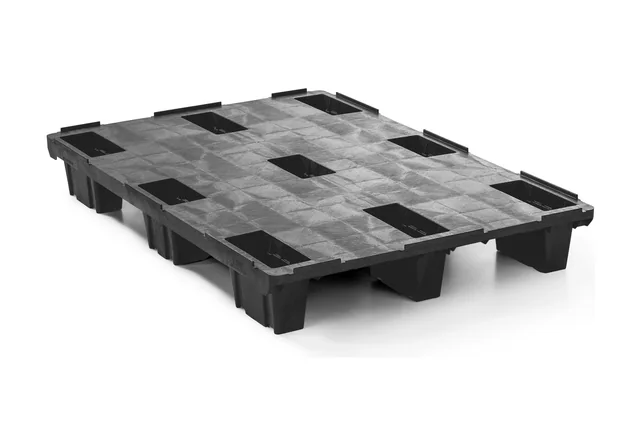
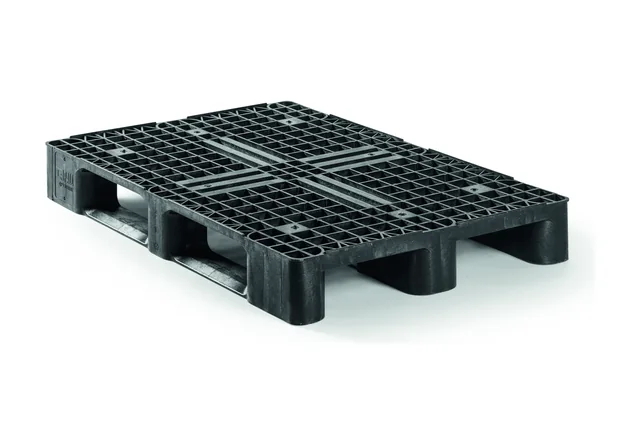
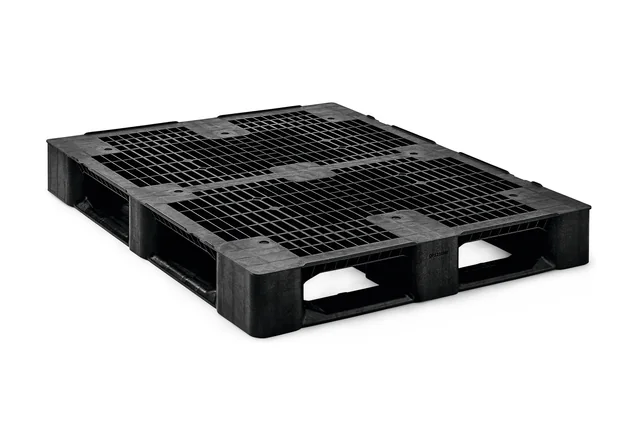
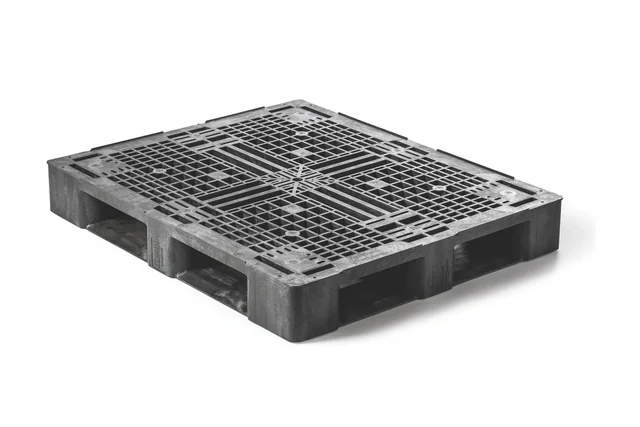
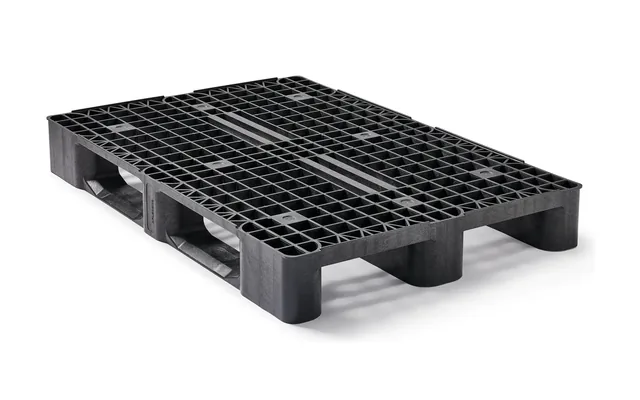
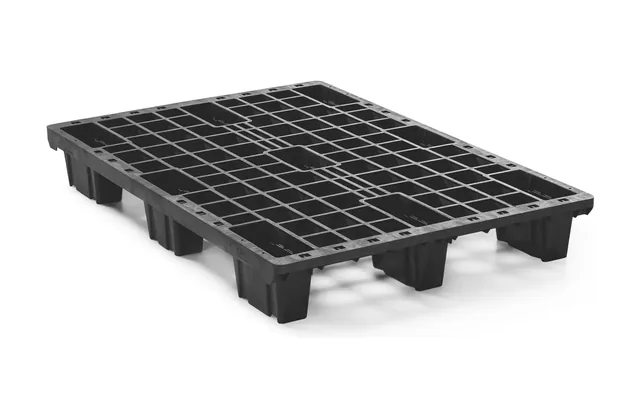
Every pallet has a top deck, which carries the load, and an underside that it rests on. In between are the openings for the forks of a forklift or pallet truck. The underside consists of separate feet or continuous runners. On a perimeter base pallet, the runners go all the way round, like a frame.
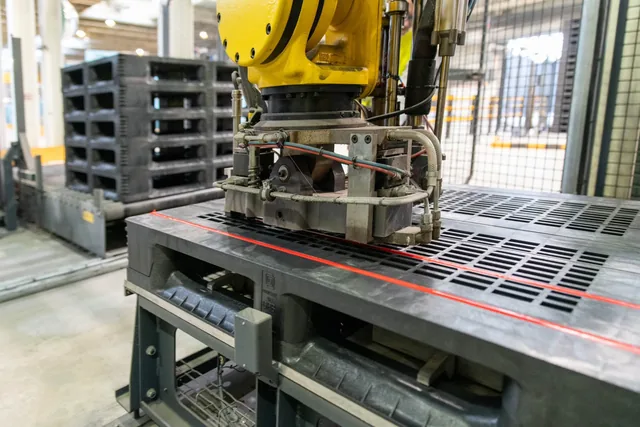
On a wooden pallet, these are separate parts nailed together. A wooden EPAL Euro pallet consists of 11 boards, 9 blocks and 78 nails. A plastic pallet is made by high-pressure injection moulding: molten plastic is pressed into a steel mould, creating a dimensionally stable pallet without nails or loose boards.
Pallet terms, such as deck, block and entry direction, are defined internationally in ISO 445. Our glossary explains them briefly.
Open or closed deck: what is the difference?
An open deck has a grid structure. It is lighter and often cheaper, and moisture drains away while air circulates around the load. A closed deck is flat and solid. Small packages cannot fall through and it is easy to clean. That is important in the food and pharmaceutical industries.
The difference in weight is visible in our range. A nestable Euro pallet with an open deck weighs 5.1 to 5.4 kg, with a closed deck 6.3 to 6.6 kg. For heavy pallets of 1200 x 1000 mm on 3 runners, the weight ranges from 19.1 to 22.6 kg with an open deck and from 21 to 27.5 kg with a closed deck.
Choose an open deck for:
- cooling and freezer rooms, where air needs to circulate;
- products that need to dry or drain;
- applications where weight and price matter most.
Choose a closed deck for:
- small packages, bags or loose products;
- hygiene-sensitive sectors, see hygienic pallets;
- loads that need extra grip: for grip, choose an anti-slip deck with TPE.
Feet or runners: what suits your process?
Feet make a pallet light and often nestable, and you can enter it from four sides. Runners give a stable base on the floor, on roller conveyors and in pallet racking. The more runners, the more support the load gets and the more evenly the weight is distributed.
| Underside | Entry | Nestable | Racking | Roller conveyor | At Q-Pall |
|---|---|---|---|---|---|
| 9 feet | Four sides, forklift and pallet truck | Yes | No | Less suitable | Light, 6 sizes |
| 3 runners | Forklift from four sides, pallet truck along the runners | Light: yes, with loose click-on runners. Medium and heavy: no | Yes, in medium and heavy | Yes | Light, medium and heavy |
| 5 runners | Forklift from four sides, pallet truck along the runners | No | Yes | Yes | Medium and heavy, 1200 x 1000 and 1300 x 1100 mm |
| 6 runners (perimeter base) | Depends on the model | No | Yes | Yes | Medium and heavy, including CP6 and CP9 |
The display pallets of 600 x 400 and 600 x 800 mm stand on 4 or 6 feet or on 3 runners and are nestable.
Pallets with 9 feet can be given a more stable base. You can click loose runners under many nestable pallets, without tools. That gives you a pallet with 3 runners on site. Read about the difference between nesting and stacking in nestable or stackable pallets.
What is the difference between two-way and four-way?
You pick up a two-way pallet from two opposite sides, a four-way pallet from all four. With a pallet on feet, a forklift and a pallet truck can get under the pallet from any side. With runners, a forklift can often enter from four sides, but a pallet truck only in the direction of the runners.
That is because the wheels of a pallet truck sit under the forks. They must be able to reach the floor between the runners. If you enter at right angles to the runners, the runners get in the way. Such a pallet is also called partial four-way.
Block pallets of 1200 x 1000 mm are designed to be picked up by a forklift from all four sides. If you work a lot with pallet trucks, check for each model from which sides you can pick it up. Every model on our site has a technical drawing with the dimensions.
What does the construction mean for racking and roller conveyors?
In pallet racking without decking, the pallet rests only on two beams. That requires runners, placed at right angles to the beams. Light pallets and pallets on feet are not intended for racking. On roller conveyors and chain conveyors, pallets with continuous runners run best.
The same applies to wood: the wooden EPAL 2 pallet has a bottom frame, so it can run on chain conveyors and roller conveyors. On plastic pallets, 3, 5 or 6 runners provide that base.
For automated warehouses, two more points count:
- Dimensional accuracy. Every plastic pallet of the same model has the same dimensions, even after years of use.
- Deflection. Besides the static and dynamic load, look at the racking load. Read more in plastic pallets for automation.
How do you choose the right construction?
Start with your process: how do you pick up the pallet, where does it stand and does it come back? If the pallet makes a single trip, a light pallet on 9 feet is often enough. If it goes into racking or over a roller conveyor, choose runners. Choose the deck based on your load and the hygiene requirements.
In short:
- Load. Small packages or hygiene requirements: closed deck. Cooling or draining: open deck.
- Picking up. A lot of pallet truck work from all sides: feet. Mainly forklift: runners are enough.
- Storage. Racking or roller conveyor: 3, 5 or 6 runners in medium or heavy. Floor storage and transport: light is often enough.
- Circulation. One-way: light and nestable. Comes back often: medium or heavy.
Want to choose step by step? Then use the guide choosing the right plastic pallet.